Skip to main content
O/L English Literature Study Guide 2026 | PaperMaster.lk | PaperMaster LK
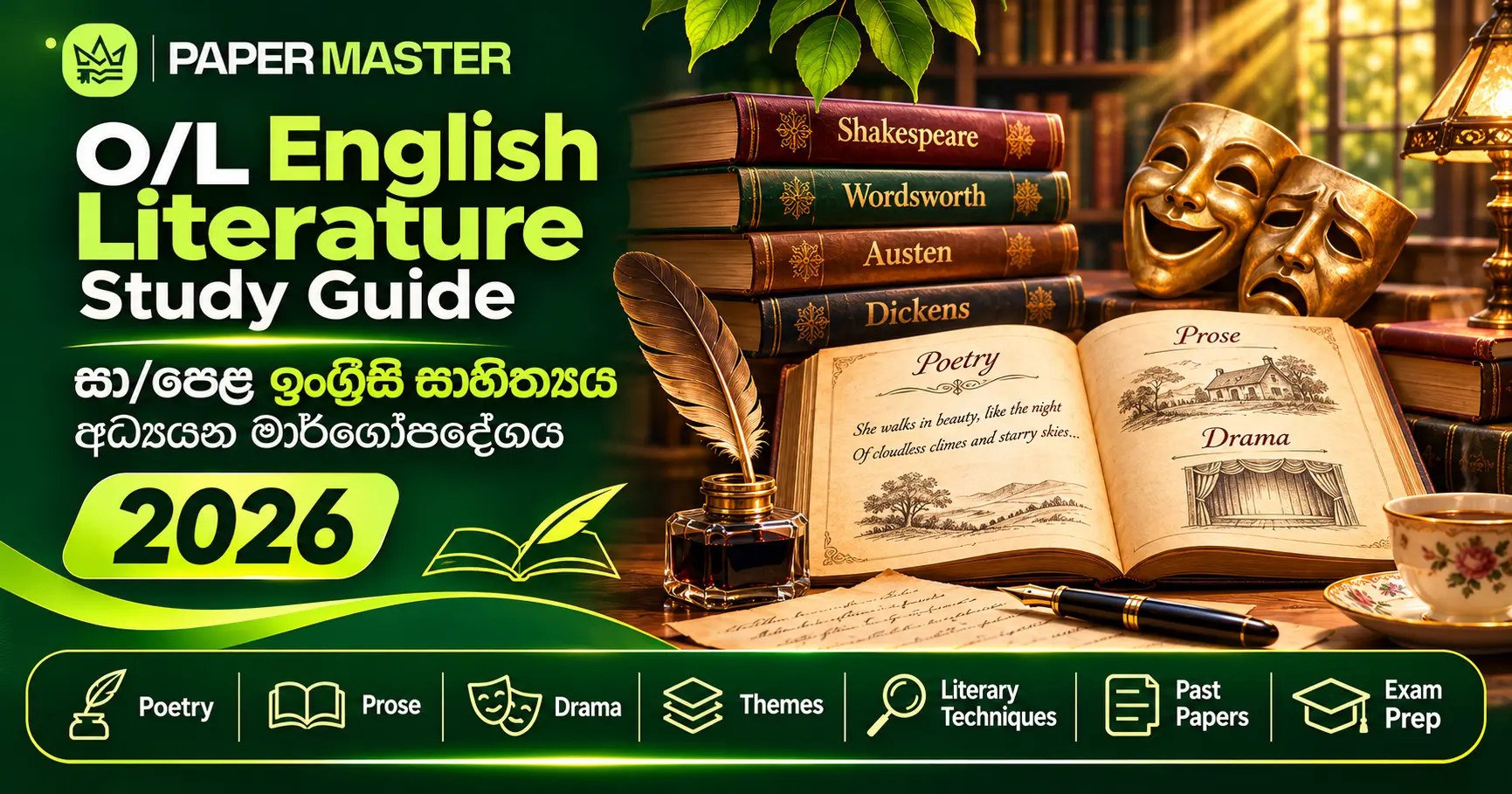
Home Study Guides O/L English Literature Study Guide 2026 – Complete Revision Guide A complete O/L English Literature Study Guide for Sri Lankan students covering poetry, prose, drama, literary techniques, character analysis, themes, quotation use, essay writing, past paper practice and exam preparation for the 2026 examination.
O/L English Literature Study Guide 2026 This O/L English Literature Study Guide is designed to help Sri Lankan students revise the important literary concepts, reading skills and answer-writing techniques required for the G.C.E. Ordinary Level English Literature examination.
English Literature becomes easier when students understand the meaning, themes, characters and techniques used in a text instead of simply memorizing notes.
What You Will Learn 1. Understanding English Literature Literature uses language creatively to communicate ideas, emotions, experiences and social issues.
Students may study different forms such as:
Ready to practise?
Browse past papers More study guides O/L Dancing Study Guide 2026 – Complete Revision Guide
A complete O/L Dancing Study Guide for Sri Lankan students covering basic dance movements, rhythm, traditional Sri Lankan dance forms, costumes, drums, performance skills, choreography, dance appreciation, past paper practice and exam preparation for the 2026 examination.
O/L Music Study Guide 2026 – Complete Revision Guide
A complete O/L Music Study Guide for Sri Lankan students covering musical elements, rhythm, melody, notation, instruments, vocal techniques, Sri Lankan traditional music, music appreciation, past paper practice and exam preparation for the 2026 examination.
O/L Drama & Theatre Study Guide 2026 – Complete Revision Guide
A complete O/L Drama & Theatre Study Guide for Sri Lankan students covering acting, script interpretation, stagecraft, character development, theatre techniques, traditional drama, performance skills, past paper practice and exam preparation for the 2026 examination.
Important Tip Do not study a text only as a story.
Think about why the writer has presented the characters, events and language in a particular way.
2. Reading the Text Carefully A strong literature answer begins with a good understanding of the original text.
Reading the original text several times is more useful than depending only on summaries.
3. Poetry Poetry often communicates ideas and emotions through carefully selected language.
When studying a poem, consider:
Poetry Tip The rhythm, pauses and sound of words can help you understand its meaning and mood.
4. Themes A theme is an important idea explored throughout a literary work.
Possible themes may include:
Do not only name a theme. Explain how the writer develops it through characters, events or language.
5. Character Analysis When analysing a character, avoid simply retelling what the character does.
Important Tip Support character descriptions with evidence from the text.
Instead of saying a character is “kind,” explain what the character says or does that shows kindness.
6. Literary Techniques Writers use different techniques to create meaning and effect.
Students should be familiar with techniques such as:
The important part is not only identifying the technique.
Explain what effect it creates.
7. Imagery Imagery uses descriptive language to create pictures, sounds, feelings or other sensory experiences in the reader's mind.
Revision Tip Avoid writing only “this creates imagery.”
Explain exactly what the reader is encouraged to imagine or feel.
8. Tone and Mood Tone refers to the attitude expressed by the writer or speaker.
Mood refers to the feeling created for the reader or audience.
Possible tones may include:
Understanding tone helps explain why particular words and techniques are used.
9. Drama Drama is written to be performed.
When studying a play, consider:
Important Tip Do not ignore stage directions.
They may reveal movement, emotion, relationships and atmosphere.
10. Prose and Short Stories When studying prose or short stories, focus on:
Think about why certain events are important rather than simply memorizing the sequence of the story.
11. Setting Setting refers to the time and place in which a story or drama occurs.
A strong answer explains why the setting is important to the text.
12. Quotations Relevant quotations can strengthen literature answers.
When learning quotations:
Quotation Tip A short quotation that is explained well is usually more useful than a long quotation with no analysis.
13. Using Evidence Literature answers should be supported with evidence.
After giving evidence, explain how it supports your point.
14. Writing Paragraphs A clear literature paragraph can follow this basic structure:
Do not simply place quotations into an answer without explaining them.
15. Essay Questions Essay questions require students to develop an argument or explanation across several paragraphs.
Important Tip Do not write everything you know about the text.
Choose only the information that helps answer the exact question.
16. Comparing Literary Texts Some questions may require comparison.
When comparing, consider:
Avoid writing about one text completely and then the other without making connections.
17. Understanding Context Context refers to the background surrounding a literary work.
Use context only when it helps explain the text.
Do not add unrelated historical information.
18. Common Mistakes to Avoid
19. Past Paper Practice Past paper practice is one of the most effective ways to prepare for the O/L English Literature examination.
Past papers help students understand how the same text can be tested from different angles.
Exam Preparation Tips
Final Advice English Literature is not a subject that can be mastered through memorization alone.
Understand the texts, think about the writer's choices and support your ideas with relevant evidence.
A strong answer should always respond directly to the question and explain how the evidence supports your interpretation.
Regular reading, quotation revision, essay practice and past paper preparation will help improve both your analytical skills and confidence.
Use PaperMaster.lk to access past papers, model papers, study guides and educational resources for your O/L examination preparation.
Good luck with your studies and your 2026 O/L examination!