Skip to main content
O/L Dancing Study Guide 2026 | PaperMaster.lk | PaperMaster LK
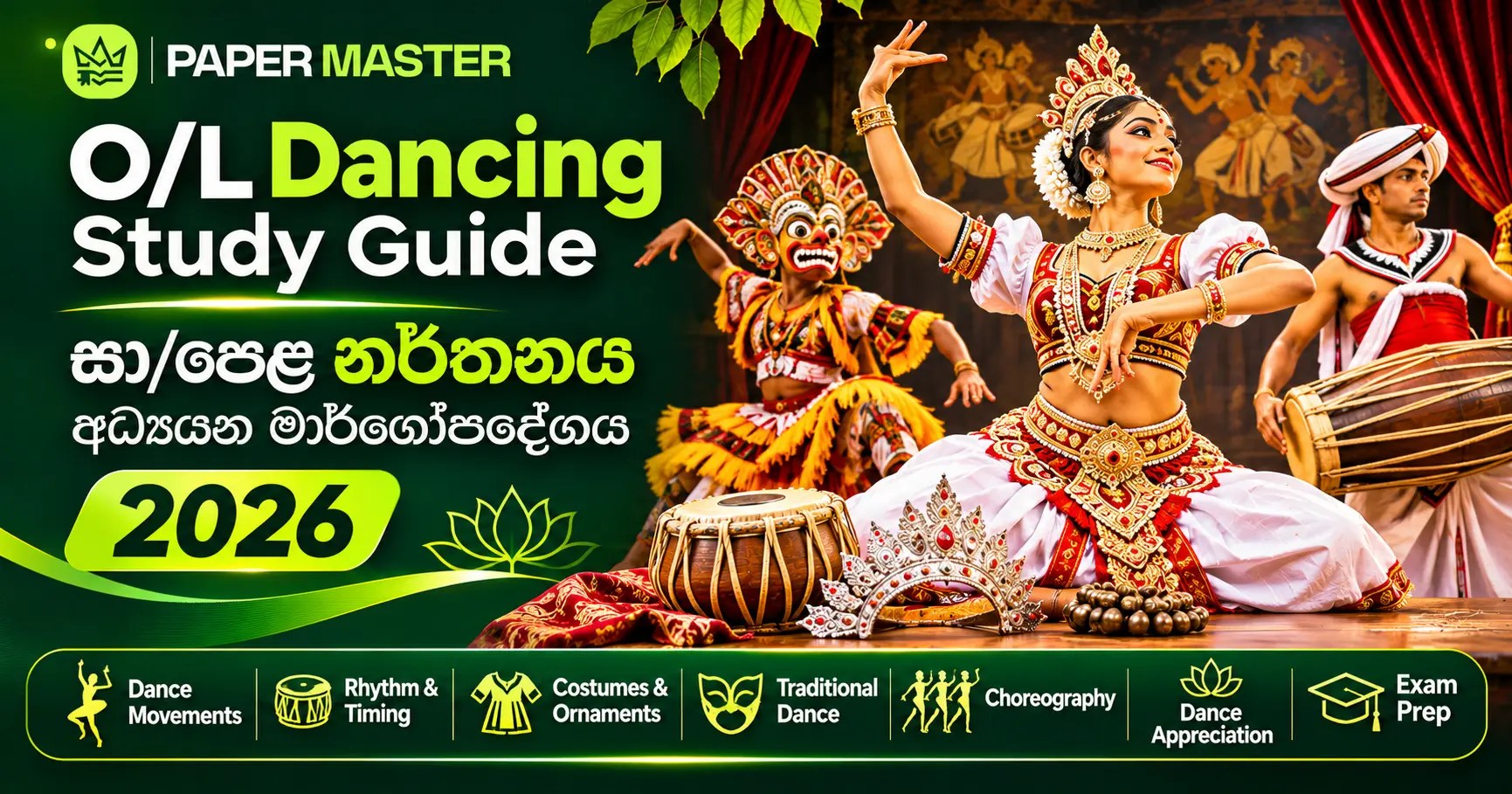
Home Study Guides O/L Dancing Study Guide 2026 – Complete Revision Guide A complete O/L Dancing Study Guide for Sri Lankan students covering basic dance movements, rhythm, traditional Sri Lankan dance forms, costumes, drums, performance skills, choreography, dance appreciation, past paper practice and exam preparation for the 2026 examination.
O/L Dancing Study Guide 2026 This O/L Dancing Study Guide is designed to help Sri Lankan students revise the important theoretical knowledge, traditional dance concepts and practical performance skills required for the G.C.E. Ordinary Level Dancing examination.
Dancing becomes easier when students combine theory with regular movement practice, rhythm exercises, observation and an understanding of Sri Lankan traditional dance culture.
What You Will Learn 1. Understanding Dance Dance is a performing art that uses body movement, rhythm, expression and space to communicate ideas, emotions and cultural traditions.
Important elements include:
Ready to practise?
Browse past papers More study guides O/L English Literature Study Guide 2026 – Complete Revision Guide
A complete O/L English Literature Study Guide for Sri Lankan students covering poetry, prose, drama, literary techniques, character analysis, themes, quotation use, essay writing, past paper practice and exam preparation for the 2026 examination.
O/L Music Study Guide 2026 – Complete Revision Guide
A complete O/L Music Study Guide for Sri Lankan students covering musical elements, rhythm, melody, notation, instruments, vocal techniques, Sri Lankan traditional music, music appreciation, past paper practice and exam preparation for the 2026 examination.
O/L Drama & Theatre Study Guide 2026 – Complete Revision Guide
A complete O/L Drama & Theatre Study Guide for Sri Lankan students covering acting, script interpretation, stagecraft, character development, theatre techniques, traditional drama, performance skills, past paper practice and exam preparation for the 2026 examination.
Important Tip Do not study dance only as theory.
Connect each concept with physical movement and actual performance whenever possible.
2. Body Movement and Coordination Good dancing requires control and coordination of different parts of the body.
Students should develop awareness of:
Practice Tip Start slowly and focus on correct technique before increasing speed.
Accurate movement is more important than performing quickly.
3. Rhythm and Timing Rhythm is one of the most important elements in dancing.
Students should understand:
Practice moving, clapping or stepping according to different rhythmic patterns.
4. Expression in Dance Dance communicates meaning through both movement and expression.
Students should pay attention to:
Important Tip Expression should match the meaning, character and mood of the performance.
5. Sri Lankan Traditional Dance Sri Lanka has a rich traditional dance heritage.
Students should understand the basic characteristics and cultural importance of major traditional dance forms.
Do not memorize only the names of dance traditions. Understand what makes each tradition distinctive.
6. Kandyan Dance Tradition Kandyan dance is one of the major traditional dance traditions of Sri Lanka.
Students should study areas such as:
Revision Tip Use photographs, videos or diagrams to identify important visual features of traditional dances.
7. Low Country Dance Tradition Low Country dance traditions have distinctive movements, rhythms, masks and performance practices.
Students should understand:
Focus on the relationship between the movement, music and cultural purpose of the performance.
8. Sabaragamuwa Dance Tradition Sabaragamuwa dance is another important Sri Lankan traditional dance tradition.
Important Tip When comparing traditional dance forms, identify both similarities and differences.
9. Traditional Drums and Musical Accompaniment Drumming and music play a major role in traditional dance.
Students should understand how musical accompaniment supports:
Important traditional drums and accompanying instruments should be identified by their appearance, use and sound.
10. Costumes and Ornaments Costumes are an important visual element of traditional dance.
Students should also understand the importance of ornaments, headpieces and other decorative elements.
11. Masks and Characterization Masks are used in some Sri Lankan traditional performances.
Revision Tip Do not memorize masks only by appearance.
Understand the type of character or performance with which they are associated.
12. Space and Formation Dancers use performance space in different ways.
Good use of space helps create a clear and visually balanced performance.
13. Dance Performance Skills A successful dance performance requires both physical skill and artistic expression.
Important skills include:
Important Tip Technical accuracy and expression should work together.
A movement may be technically correct but still look weak if it lacks confidence and expression.
14. Choreography Choreography is the process of planning and arranging movements to create a dance.
When developing a dance sequence, consider:
Simple movements can create an effective performance when they are organized well.
15. Group Dancing Group dancing requires performers to work together.
Important qualities include:
Students should understand that one dancer's timing can affect the entire group performance.
16. Dance and Culture Traditional dance is closely connected with history, religion, rituals, celebrations and community life.
When studying a dance tradition, consider:
Understanding the cultural background makes theoretical answers stronger.
17. Dance Appreciation Dance appreciation involves observing and analysing a performance.
When watching a dance, consider:
Important Tip Avoid giving only general comments such as “the dance was beautiful.”
Explain which elements made the performance effective.
18. Preparing for a Performance Regular rehearsal helps improve confidence, coordination and timing.
19. Past Paper Practice Past paper practice is one of the best ways to prepare for the O/L Dancing examination.
Past papers help students understand how theoretical knowledge and practical understanding are tested.
Common Mistakes to Avoid
Exam Preparation Tips
Final Advice Dancing improves through regular practice, observation and understanding.
Do not depend only on memorizing theoretical notes.
Connect movements, rhythm, costumes, music and cultural background when studying traditional dance.
Regular revision, practical practice and past paper preparation will help improve both your knowledge and confidence before the examination.
Use PaperMaster.lk to access past papers, model papers, study guides and educational resources for your O/L examination preparation.
Good luck with your studies and your 2026 O/L examination!