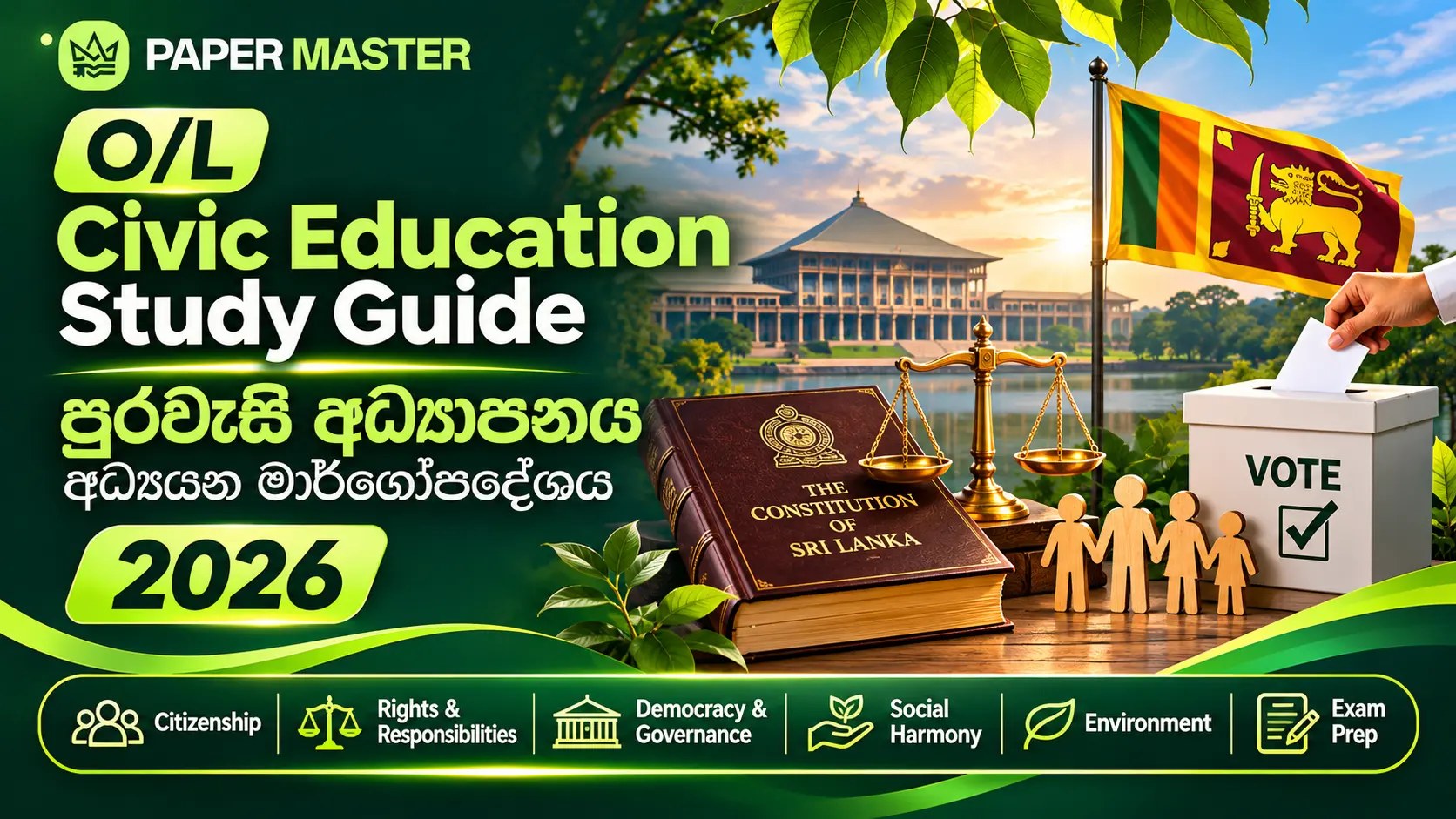
O/L Civic Education Study Guide 2026 – Complete Revision Guide
A complete O/L Civic Education Study Guide for Sri Lankan students covering citizenship, democracy, rights and responsibilities, governance, law, elections, social harmony, environmental responsibility, past paper practice and exam preparation for the 2026 examination.
O/L Civic Education Study Guide 2026
This O/L Civic Education Study Guide is designed to help Sri Lankan students revise the important concepts, values and social responsibilities required for the G.C.E. Ordinary Level Civic Education examination.
Civic Education becomes easier when students connect the lessons with real-life situations in society instead of simply memorizing definitions.
What You Will Learn
Citizenship
Rights and responsibilities
Democracy
Good governance
Rule of law
Elections and representation
National unity
Social harmony
Local government
Public services
Environmental responsibility
Media and communication
Global citizenship
Past paper preparation
Exam time management
1. Understanding Citizenship
Citizenship refers to the relationship between an individual and the country to which he or she belongs.
A responsible citizen should understand both rights and responsibilities.
Think about how a responsible citizen behaves at home, school and in society.
2. Rights and Responsibilities
Citizens have rights that help protect their freedom, dignity and well-being.
At the same time, citizens also have responsibilities toward society.
Students should understand examples of:
Individual rights
Social rights
Educational rights
Responsibilities toward others
Responsibility to obey laws
Responsibility to protect public property
Responsibility to protect the environment
Revision Tip
When answering a question about rights, try to mention the related responsibility as well.
Rights and responsibilities should work together.
3. Democracy
Democracy is a system in which people participate in making decisions about how a country is governed.
Important democratic principles include:
Participation
Equality
Representation
Freedom
Accountability
Respect for different opinions
Free and fair elections
Students should understand why citizen participation is important in a democratic society.
4. Elections and Representation
Elections allow citizens to choose representatives.
Students should understand basic ideas such as:
Voting
Candidates
Representation
Election campaigns
Voter responsibility
Free and fair elections
Important Tip
Voting is not only a right. It is also an important civic responsibility.
Citizens should make informed and responsible choices.
5. Good Governance
Good governance refers to the responsible and effective management of public affairs.
Important characteristics include:
Transparency
Accountability
Participation
Equality
Efficiency
Fairness
Responsiveness
Students should understand how good governance benefits citizens and society.
6. Rule of Law
The rule of law means that everyone is subject to the law.
No person should be above the law.
Important ideas include:
Equality before the law
Fair treatment
Protection of rights
Legal responsibility
Respect for legal institutions
Revision Tip
Use simple examples to explain why laws are necessary for maintaining order and protecting people.
7. Government and Public Institutions
Governments perform many functions that affect everyday life.
Students should understand areas such as:
Education
Health services
Security
Transportation
Public administration
Infrastructure
Environmental protection
Social services
Public institutions help provide services and maintain the functioning of society.
8. Local Government
Local government institutions provide services within local communities.
These services may include:
Waste management
Road maintenance
Public health
Community facilities
Environmental cleanliness
Local development activities
Students should understand the importance of citizen participation in local community development.
9. National Unity
Sri Lanka is a diverse country with different communities, languages, cultures and traditions.
National unity can be strengthened through:
Mutual respect
Cooperation
Equality
Understanding
Tolerance
Peaceful communication
Respect for cultural diversity
Important Tip
Avoid thinking of diversity as a weakness.
Different cultures and traditions can contribute to the richness of society.
10. Social Harmony
Social harmony means living peacefully and respectfully with others.
Important values include:
Respect
Empathy
Cooperation
Tolerance
Non-violence
Fairness
Dialogue
Students should understand how conflicts can be resolved through peaceful communication and mutual understanding.
11. Public Property
Public property belongs to the community and should be protected.
Examples include:
Schools
Roads
Parks
Public transport
Libraries
Government buildings
Public utilities
Damaging public property affects everyone.
Responsible citizens should protect and use public resources carefully.
12. Environmental Responsibility
Citizens also have responsibilities toward the environment.
Important actions include:
Reducing waste
Reusing materials
Recycling
Saving water
Saving electricity
Protecting forests
Avoiding pollution
Keeping public places clean
Environmental Tip
Environmental protection is not only the responsibility of the government.
Individuals and communities also have an important role.
13. Media and Responsible Communication
Media plays an important role in modern society.
Students should understand different forms of media such as:
Television
Radio
Newspapers
Websites
Social media
Online communication platforms
Responsible media use includes:
Checking information before sharing it
Respecting others
Avoiding harmful content
Protecting privacy
Identifying misinformation
14. Digital Citizenship
Digital citizenship refers to responsible behaviour when using digital technologies.
Important areas include:
Online safety
Privacy
Respectful communication
Responsible social media use
Protecting passwords
Avoiding cyberbullying
Identifying false information
Students should understand that responsible behaviour is important both online and offline.
15. Community Participation
Citizens can contribute to their communities in many ways.
Examples include:
Volunteering
Helping people in need
Participating in community projects
Protecting the environment
Supporting school activities
Keeping public areas clean
Participating in awareness programmes
Community participation helps build stronger relationships and responsible citizens.
16. Conflict Resolution
Conflicts may occur when people have different opinions, needs or interests.
Healthy methods of resolving conflicts include:
Listening
Discussion
Negotiation
Respecting different viewpoints
Finding common solutions
Avoiding violence
Important Tip
When answering conflict-resolution questions, explain both the problem and a peaceful method of solving it.
17. Global Citizenship
Global citizenship means understanding that people are connected across countries and communities.
Important areas include:
Human dignity
Peace
Environmental protection
Cultural understanding
International cooperation
Sustainable development
Respect for diversity
Students should understand how local actions can sometimes have wider global effects.
18. Writing Civic Education Answers
A good Civic Education answer should be clear, relevant and supported by examples.
When answering:
Read the question carefully
Identify the key requirement
Give the correct concept
Explain it clearly
Use practical examples
Organize longer answers into paragraphs
Avoid unrelated information
Important Tip
A simple real-life example can make an answer much stronger.
19. Past Paper Practice
Past paper practice is one of the best ways to prepare for the O/L Civic Education examination.
Try to:
Complete past papers regularly
Practice multiple-choice questions
Practice structured questions
Identify frequently tested topics
Review incorrect answers
Create short notes for weak areas
Practice within the examination time
Past papers can help students understand how civic concepts are tested in different situations.
Common Mistakes to Avoid
Memorizing definitions without understanding them
Giving incomplete explanations
Confusing rights and responsibilities
Writing unrelated information
Not using real-life examples
Ignoring the exact requirement of the question
Writing very long answers without clear points
Spending too much time on one question
Exam Preparation Tips
Create a weekly revision plan
Study one topic at a time
Prepare short notes
Learn important terms
Use real-life examples
Practice structured answers
Complete past papers
Review your mistakes
Manage examination time carefully
Final Advice
Civic Education becomes easier when you connect the lessons with everyday life and society.
Try to understand how citizenship, rights, responsibilities, democracy, law, social harmony and environmental responsibility influence your daily life.
Regular revision, real-life examples and past paper practice will help improve both your knowledge and confidence before the examination.
Use PaperMaster.lk to access past papers, model papers, study guides and educational resources for your O/L examination preparation.
Good luck with your studies and your 2026 O/L examination!