Skip to main content
O/L Art Study Guide 2026 | PaperMaster.lk | PaperMaster LK
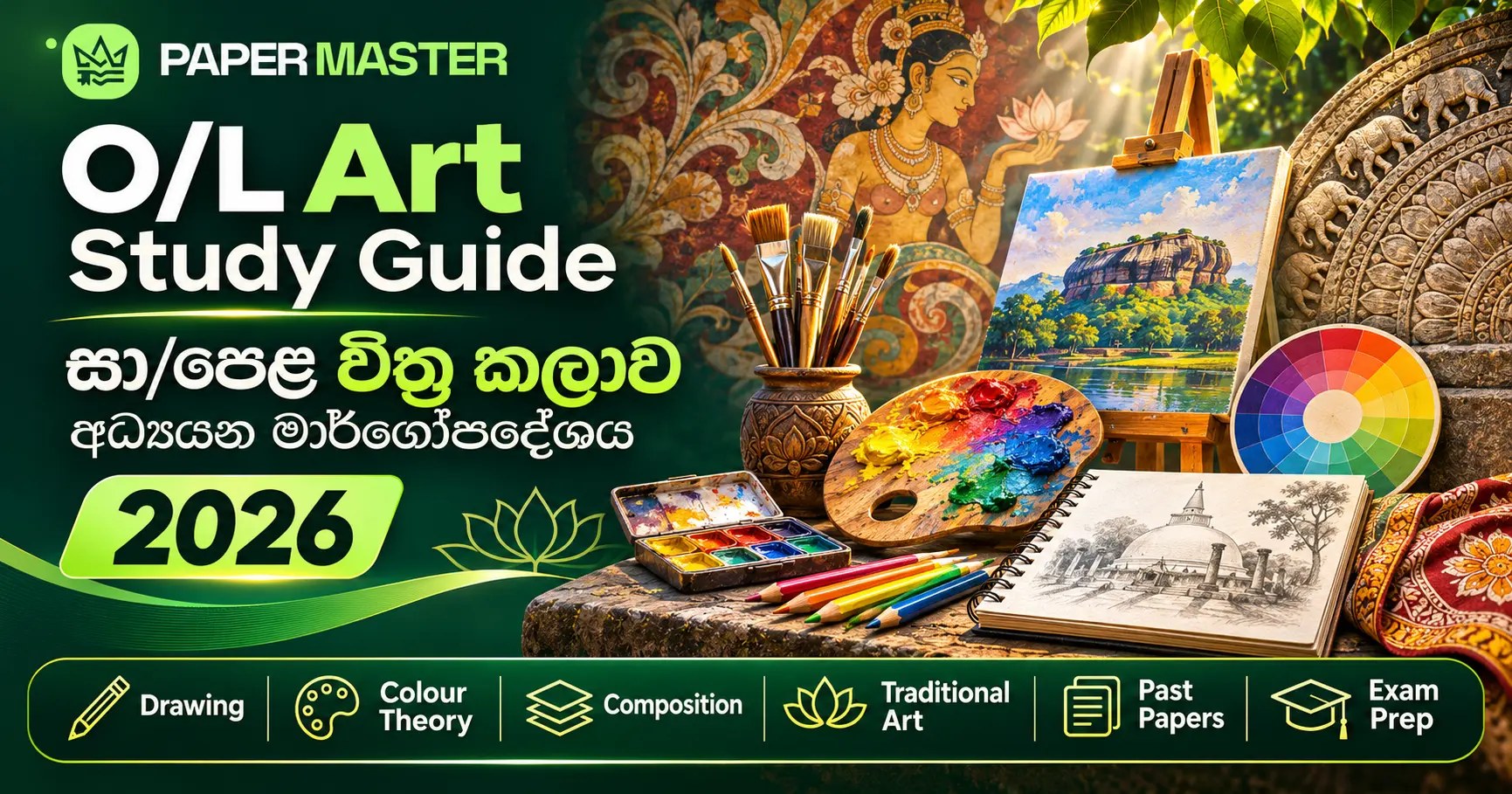
Home Study Guides O/L Art Study Guide 2026 – Complete Revision Guide A complete O/L Art Study Guide for Sri Lankan students covering drawing, colour theory, composition, design, traditional Sri Lankan art, art appreciation, creative techniques, past paper practice and exam preparation for the 2026 examination.
O/L Art Study Guide 2026 This O/L Art Study Guide is designed to help Sri Lankan students revise the important artistic concepts, practical skills and art appreciation knowledge required for the G.C.E. Ordinary Level Art examination.
Art becomes easier when students combine theoretical knowledge with regular drawing, observation and creative practice instead of relying only on memorization.
What You Will Learn 1. Basic Drawing Skills Drawing is one of the most important foundations of Art.
Students should practice observing objects carefully before drawing them.
Important areas include:
Ready to practise?
Browse past papers More study guides O/L English Literature Study Guide 2026 – Complete Revision Guide
A complete O/L English Literature Study Guide for Sri Lankan students covering poetry, prose, drama, literary techniques, character analysis, themes, quotation use, essay writing, past paper practice and exam preparation for the 2026 examination.
O/L Dancing Study Guide 2026 – Complete Revision Guide
A complete O/L Dancing Study Guide for Sri Lankan students covering basic dance movements, rhythm, traditional Sri Lankan dance forms, costumes, drums, performance skills, choreography, dance appreciation, past paper practice and exam preparation for the 2026 examination.
O/L Music Study Guide 2026 – Complete Revision Guide
A complete O/L Music Study Guide for Sri Lankan students covering musical elements, rhythm, melody, notation, instruments, vocal techniques, Sri Lankan traditional music, music appreciation, past paper practice and exam preparation for the 2026 examination.
Important Tip Do not rush to add details.
First establish the basic shape, size and proportion of the object before developing the drawing.
2. Line, Shape and Form Lines and shapes are basic visual elements used to create artworks.
Students should understand different types of lines and how they can communicate:
Shapes may be geometric or organic, while form gives the impression of three-dimensional volume.
3. Colour Theory Colour is an important element in art and design.
Students should understand:
Colour Tip Practice mixing colours instead of only memorizing colour relationships.
This helps you understand how different colours behave when combined.
4. Tone and Shading Tone refers to the lightness and darkness of a colour or surface.
Shading helps create the illusion of three-dimensional form.
Students should practice:
Observe where the light source comes from before adding shadows.
5. Perspective Perspective helps create depth and distance in a drawing.
Students should understand basic ideas such as:
Important Tip Objects generally appear smaller as they move further away from the viewer.
Practicing simple perspective drawings can make complex scenes easier.
6. Composition Composition refers to the arrangement of visual elements within an artwork.
A good composition may consider:
Students should avoid placing every object randomly.
Plan the arrangement before starting the final artwork.
7. Still-Life Drawing Still-life drawing involves arranging and drawing objects such as:
Students should pay attention to:
Practice Tip Start with simple objects and gradually move to more complex arrangements.
8. Drawing Natural Forms Nature provides many useful subjects for artistic study.
Observe the natural structure instead of drawing from memory whenever possible.
9. Human Form and Figure Drawing Understanding the human figure helps students create more realistic and expressive artworks.
Do not focus on small details before establishing the overall pose.
10. Design Principles Design combines visual elements to communicate an idea or create an attractive composition.
Important principles include:
Students should understand how these principles can be used in posters, decorations, patterns and other designs.
11. Decorative Art and Patterns Decorative design may involve repeated shapes, motifs and colours.
Design Tip A successful pattern should have consistency while still remaining visually interesting.
12. Sri Lankan Traditional Art Sri Lanka has a rich artistic and cultural heritage.
Students should become familiar with important areas such as:
Try to understand the cultural importance of these artistic traditions.
13. Buddhist and Historical Art Religious and historical art forms are important parts of Sri Lankan visual culture.
When studying an artwork, do not only memorize its name.
Understand what makes it visually and culturally important.
14. Art Appreciation Art appreciation involves observing, understanding and discussing an artwork.
When analysing an artwork, consider:
Important Tip Support your opinion with visible features from the artwork.
Avoid giving only general comments such as “it is beautiful.”
15. Materials and Techniques Different materials create different visual effects.
Students may work with or study:
Students should understand the basic characteristics and suitable uses of each medium.
16. Creative Expression Art allows students to communicate ideas, experiences and emotions visually.
Creative work may be inspired by:
Originality is important, but the artwork should still have clear structure and visual organization.
17. Planning an Artwork Before starting a final artwork:
Planning can help reduce mistakes and improve the final result.
18. Common Practical Mistakes Regular practice is the best way to improve these areas.
19. Past Paper Practice Past paper practice can help students understand the type of theoretical and practical questions that may appear in the O/L Art examination.
Exam Preparation Tips
Final Advice Art improves through regular observation and practice.
Do not wait until the examination period to begin drawing regularly.
Combine practical drawing, creativity, art theory and appreciation when preparing for the examination.
Use PaperMaster.lk to access past papers, model papers, study guides and educational resources for your O/L examination preparation.
Good luck with your studies and your 2026 O/L examination!