Skip to main content
O/L Tamil Language & Literature Guide 2026 | PaperMaster.lk | PaperMaster LK
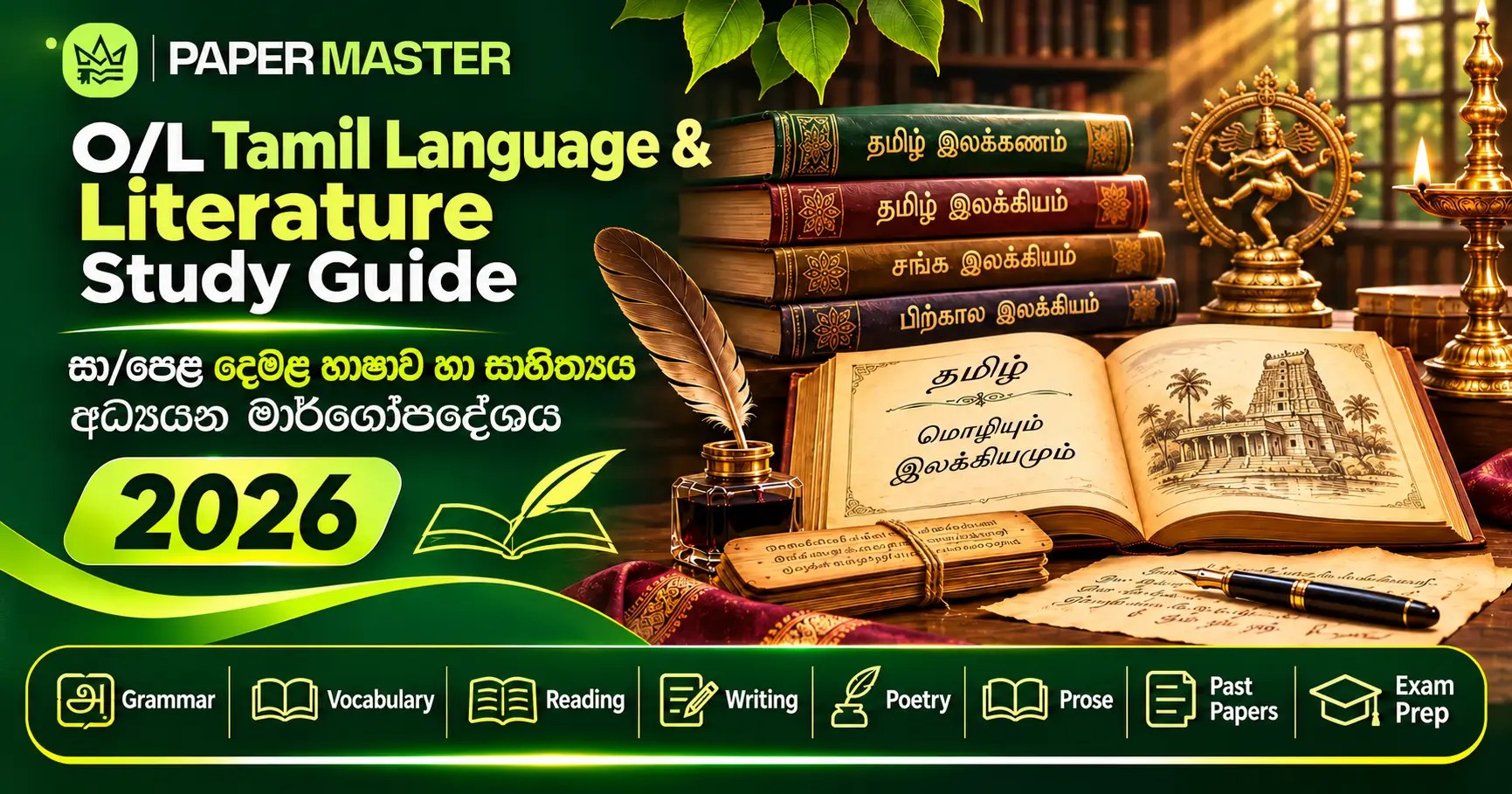
Home Study Guides O/L Tamil Language & Literature Study Guide 2026 – Complete Revision Guide A complete O/L Tamil Language & Literature Study Guide for Sri Lankan students covering grammar, vocabulary, reading comprehension, writing, literature, poetry, prose, language usage, past paper practice and exam preparation for the 2026 examination.
O/L Tamil Language & Literature Study Guide 2026 This O/L Tamil Language & Literature Study Guide is designed to help Sri Lankan students revise the important language skills, grammar concepts, reading techniques and literary knowledge required for the G.C.E. Ordinary Level examination.
Tamil Language & Literature becomes easier when students regularly read, write, practice grammar and understand literary texts instead of relying only on memorization.
What You Will Learn 1. Building Strong Language Skills Good language skills are the foundation of success in Tamil Language & Literature.
Students should regularly practice:
Ready to practise?
Browse past papers More study guides O/L Entrepreneurship Studies Study Guide 2026 – Complete Revision Guide
A complete O/L Entrepreneurship Studies Study Guide for Sri Lankan students covering entrepreneurship, business ideas, opportunity identification, creativity, market research, business planning, finance, marketing, customer service, risk management, past paper practice and exam preparation for the 2026 examination.
O/L Communication & Media Studies Study Guide 2026 – Complete Revision Guide
A complete O/L Communication & Media Studies Study Guide for Sri Lankan students covering communication processes, verbal and non-verbal communication, print and electronic media, news, advertising, social media, media literacy, ethics, past paper practice and exam preparation for the 2026 examination.
O/L English Literature Study Guide 2026 – Complete Revision Guide
A complete O/L English Literature Study Guide for Sri Lankan students covering poetry, prose, drama, literary techniques, character analysis, themes, quotation use, essay writing, past paper practice and exam preparation for the 2026 examination.
Important Tip Short daily practice is more useful than studying a large amount only before the examination.
2. Tamil Grammar Grammar helps students use the language correctly and clearly.
Important areas may include:
Students should understand how grammar works inside sentences instead of memorizing rules separately.
3. Vocabulary Development A strong vocabulary helps improve both comprehension and writing.
Students can develop vocabulary by:
Vocabulary Tip Do not learn a word alone.
Learn its meaning and use it in a sentence.
4. Sentence Construction Clear sentences are important in every section of the examination.
Students should practice:
Always reread a sentence to check whether it communicates the intended meaning clearly.
5. Reading Comprehension Reading comprehension tests how well students understand a passage.
When answering comprehension questions:
Important Tip Read the question before deciding which part of the passage to use.
6. Understanding the Main Idea A passage usually contains one or more important ideas.
Students should learn to identify:
This skill is useful in both language and literature questions.
7. Paragraph Writing A good paragraph should focus on one main idea.
A simple structure can include:
Writing Tip Plan the main idea before writing.
This helps avoid repeating the same point.
8. Essay Writing Essay writing requires clear organization and relevant content.
Do not write everything you know if it does not relate to the question.
9. Functional Writing Students may need to use Tamil for practical communication.
Practice different forms of writing such as:
The language and format should match the purpose.
10. Correct Spelling and Punctuation Spelling and punctuation affect the clarity of writing.
Important Tip Leave a few minutes at the end of the examination to check your writing.
11. Studying Literature Literature should be understood rather than memorized as a collection of notes.
When studying a literary text, consider:
Try to explain why each important event or character matters.
12. Poetry Poetry often communicates ideas, emotions and experiences through carefully selected language.
When studying a poem, consider:
Poetry Tip Read the poem more than once and try to understand the overall meaning before studying individual lines.
13. Prose When studying prose, students should understand:
Avoid retelling the entire story when a question asks about only one character or theme.
14. Character Analysis When answering a character question, consider:
Support your answer with relevant examples from the text.
15. Themes and Messages Literary texts often explore important themes.
Possible themes may relate to:
Important Tip Do not only name the theme.
Explain how the writer develops it through characters and events.
16. Literary Appreciation Literary appreciation involves understanding how a text creates meaning and emotion.
Students should pay attention to:
When possible, explain the effect created by the writer's technique.
17. Answering Literature Questions A strong literature answer should directly respond to the question.
Avoid writing general information that does not answer the question.
18. Improving Writing Quality To improve Tamil writing:
Regular writing practice improves accuracy and confidence.
19. Past Paper Practice Past paper practice is one of the best ways to prepare for the O/L Tamil Language & Literature examination.
Past papers help students become familiar with the style and structure of examination questions.
Common Mistakes to Avoid
Exam Preparation Tips
Final Advice Tamil Language & Literature improves through regular reading and writing.
Do not depend only on memorized notes or essays.
Build strong grammar, vocabulary and comprehension skills while developing a clear understanding of literary texts.
Regular practice, careful revision and past paper preparation will help improve both your language accuracy and examination confidence.
Use PaperMaster.lk to access past papers, model papers, study guides and educational resources for your O/L examination preparation.
Good luck with your studies and your 2026 O/L examination!