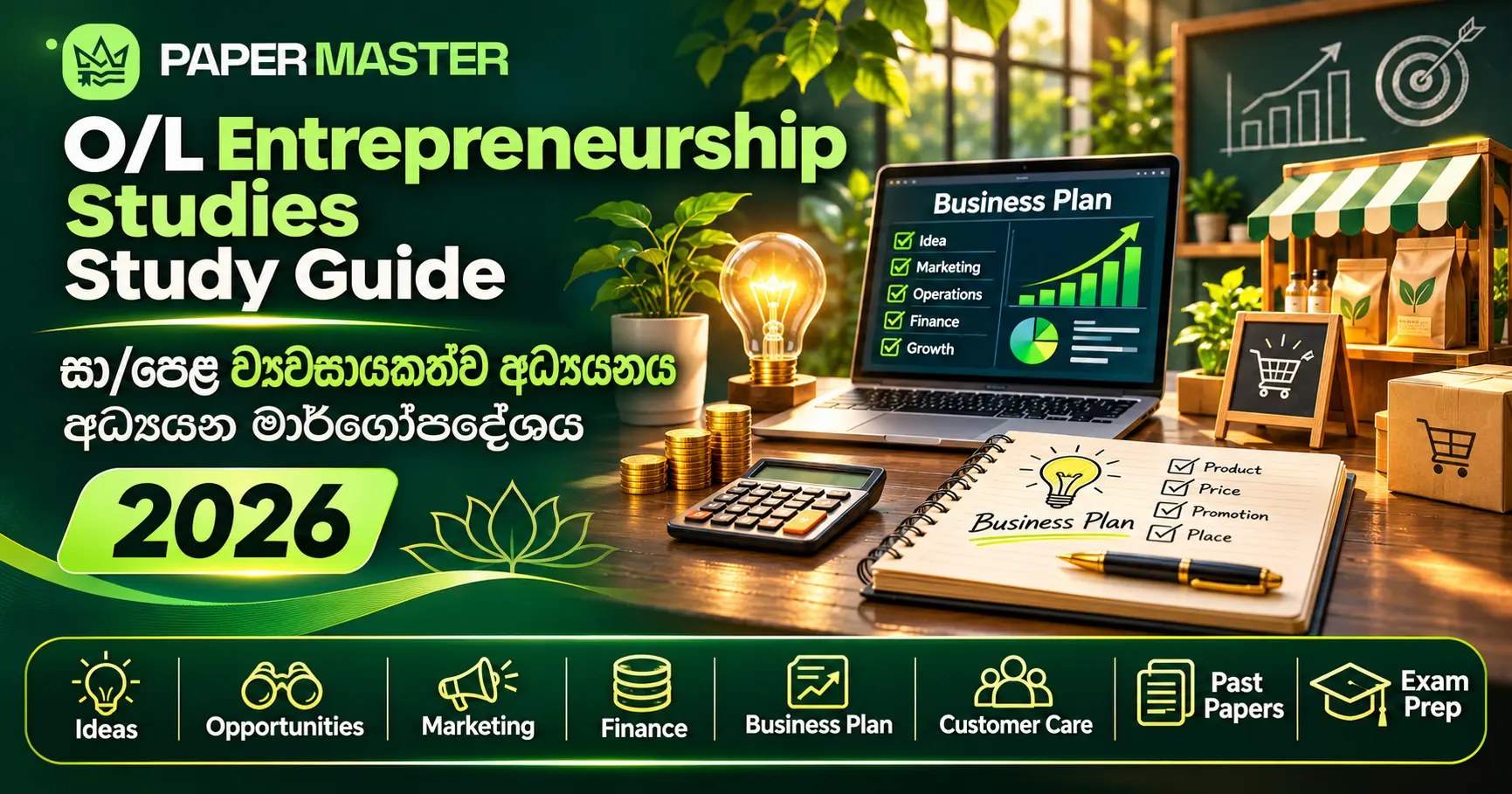
O/L Entrepreneurship Studies Study Guide 2026 – Complete Revision Guide
A complete O/L Entrepreneurship Studies Study Guide for Sri Lankan students covering entrepreneurship, business ideas, opportunity identification, creativity, market research, business planning, finance, marketing, customer service, risk management, past paper practice and exam preparation for the 2026 examination.
O/L Entrepreneurship Studies Study Guide 2026
This O/L Entrepreneurship Studies Study Guide is designed to help Sri Lankan students revise the important entrepreneurial concepts, business knowledge and practical decision-making skills required for the G.C.E. Ordinary Level examination.
Entrepreneurship Studies becomes easier when students connect the lessons with real businesses, products, customers and everyday economic activities instead of simply memorizing definitions.
Entrepreneurship is the process of identifying an opportunity, organizing resources and taking calculated risks to create value through a business or other productive activity.
Entrepreneurship can contribute to:
Employment
Income generation
Innovation
Economic development
Community development
New products and services
Important Tip
Do not study entrepreneurship only as a definition.
Think about small and large businesses around you and identify how they solve customer problems.
2. Who Is an Entrepreneur?
An entrepreneur is a person who identifies opportunities and organizes resources to develop a business or productive activity.
Important qualities may include:
Creativity
Confidence
Initiative
Responsibility
Leadership
Persistence
Decision-making ability
Willingness to take calculated risks
Revision Tip
When explaining an entrepreneurial quality, include a simple example showing how that quality may help a business.
3. Business Ideas
A business begins with an idea.
Business ideas may come from:
Customer problems
Personal skills
Hobbies
New technology
Local resources
Market trends
Existing products
Community needs
A good business idea should provide value to customers.
4. Identifying Business Opportunities
Not every business idea becomes a good business opportunity.
Before selecting an opportunity, consider:
Customer demand
Competition
Available resources
Cost
Skills required
Market size
Possible profit
Risks
Important Tip
A business opportunity should solve a real need or provide a useful benefit to customers.
5. Creativity and Innovation
Creativity is the ability to generate useful new ideas.
Innovation is the process of applying new or improved ideas in practice.
Innovation may involve:
New products
Better services
Improved packaging
New production methods
Better customer experiences
Digital solutions
Entrepreneurs should continuously look for ways to improve.
6. Understanding Customer Needs
Customers buy products or services because they expect a benefit.
Entrepreneurs should understand:
What customers need
What customers want
How much they can pay
What quality they expect
Where they prefer to buy
What problems they experience
Customer Tip
A successful business should focus on creating value for customers rather than simply trying to sell a product.
7. Market Research
Market research is the process of collecting and analysing information about customers, competitors and the market.
Information may be collected using:
Questionnaires
Interviews
Observation
Online surveys
Existing reports
Customer feedback
Market research can help reduce uncertainty before making business decisions.
8. Understanding Competition
Competitors are other businesses that offer similar products or services.
When analysing competition, consider:
Price
Quality
Location
Customer service
Product features
Promotion
Reputation
Important Tip
Competition is not always negative.
It can encourage businesses to improve their products, prices and services.
9. Business Resources
Businesses require different resources.
Important resource categories may include:
Human resources
Financial resources
Physical resources
Natural resources
Information
Technology
Entrepreneurs should use resources efficiently to reduce unnecessary costs and waste.
10. Business Planning
A business plan describes how a business is expected to operate.
A basic plan may include:
Business idea
Product or service
Target customers
Marketing approach
Required resources
Costs
Expected income
Risks
Business goals
Planning Tip
A business plan should be realistic and based on available information rather than guesses.
11. Target Market
A target market is the specific group of customers a business wants to serve.
Customers may be grouped according to factors such as:
Age
Income
Location
Interests
Occupation
Lifestyle
Buying behaviour
Understanding the target market helps a business make better marketing decisions.
12. Marketing
Marketing involves identifying customer needs and communicating the value of a product or service.
Important marketing decisions include:
Product
Price
Place
Promotion
Businesses should ensure these decisions match the needs of their target customers.
13. Product and Service Decisions
A product or service should provide value to the customer.
Entrepreneurs should consider:
Quality
Design
Features
Packaging
Reliability
Customer needs
After-sales service
Important Tip
A business should not add unnecessary features that increase cost without providing useful value to customers.
14. Pricing
Price affects both customers and business income.
Pricing decisions may consider:
Production cost
Competitor prices
Customer expectations
Demand
Desired profit
Product quality
A price should be attractive to customers while still supporting the sustainability of the business.
15. Promotion
Promotion is used to inform customers about a product or service.
Promotion methods may include:
Posters
Leaflets
Social media
Online advertising
Personal selling
Special offers
Events
Word-of-mouth
Promotion Tip
Choose promotional methods that are suitable for the target audience.
16. Business Finance
Businesses need money to start and operate.
Students should understand basic concepts such as:
Capital
Income
Expenses
Revenue
Cost
Profit
Loss
Savings
Basic financial knowledge helps entrepreneurs make responsible decisions.
17. Budgeting
A budget is a financial plan that estimates income and expenses.
A business budget can help:
Control spending
Plan purchases
Identify financial needs
Reduce unnecessary costs
Monitor business performance
Important Tip
Actual income and expenses should be compared with the budget regularly.
18. Profit and Loss
Profit occurs when business income is greater than business expenses.
Loss occurs when expenses are greater than income.
Entrepreneurs should understand that sales alone do not indicate whether a business is successful.
Costs must also be considered.
19. Sources of Finance
A business may obtain finance from different sources.
Examples may include:
Personal savings
Family contributions
Business partners
Loans
Other suitable financial sources
Before obtaining finance, entrepreneurs should consider the cost, repayment conditions and level of risk.
20. Risk in Business
Every business faces some level of risk.
Possible risks include:
Low customer demand
Increasing costs
Competition
Equipment failure
Financial difficulties
Changes in technology
Supply problems
Risk Management Tip
Entrepreneurs should identify possible risks early and develop suitable responses instead of ignoring them.
21. Customer Service
Good customer service can help a business build trust and encourage repeat purchases.
Good customer service includes:
Respect
Clear communication
Listening to customers
Responding to complaints
Keeping promises
Providing accurate information
Satisfied customers can help strengthen a business's reputation.
22. Business Ethics
Entrepreneurs should operate responsibly and fairly.
Ethical business practices include:
Honest advertising
Fair treatment of customers
Respecting employees
Providing safe products
Following laws and regulations
Protecting customer information
Ethical behaviour helps create long-term trust.
23. Sustainable Entrepreneurship
Businesses should consider their economic, social and environmental impact.
Sustainable practices may include:
Reducing waste
Saving energy
Using resources efficiently
Reusing materials
Responsible packaging
Supporting local communities
Sustainability Tip
A successful business should consider long-term value instead of focusing only on short-term profit.
24. Digital Entrepreneurship
Digital technologies have created new opportunities for entrepreneurs.
Examples include:
Online stores
Social media marketing
Digital services
Online bookings
Content creation
Remote services
Students should also understand the importance of online safety, customer privacy and responsible digital communication.
25. Business Communication
Clear communication is essential in business.
Entrepreneurs may need to communicate with:
Customers
Employees
Suppliers
Business partners
Financial institutions
Good communication should be clear, professional and suitable for the audience.
26. Decision Making
Entrepreneurs regularly make decisions.
A simple decision-making process may involve:
Identifying the problem
Collecting information
Considering alternatives
Evaluating advantages and disadvantages
Selecting an option
Reviewing the result
Good decisions should be based on relevant information whenever possible.
27. Preparing Simple Business Ideas
When developing a business idea for an examination question, clearly explain:
What the product or service is
Who the customers are
What need it satisfies
Required resources
How it will be promoted
Possible costs
Possible risks
This helps demonstrate practical understanding.
28. Past Paper Practice
Past paper practice is one of the best ways to prepare for the O/L Entrepreneurship Studies examination.
Try to:
Complete past papers regularly
Practice MCQ questions
Practice structured questions
Analyse business situations
Practice opportunity-identification questions
Review marketing concepts
Practice simple financial questions
Review incorrect answers
Complete questions within the examination time
Past papers help students understand how entrepreneurial concepts are applied to practical business situations.
Common Mistakes to Avoid
Memorizing definitions without understanding them
Confusing an idea with a business opportunity
Ignoring customer needs
Giving unrealistic business examples
Confusing revenue and profit
Ignoring business costs
Writing unrelated information
Giving answers without practical examples
Spending too much time on one question
Exam Preparation Tips
Create short notes for key terms
Learn real-world business examples
Practice identifying opportunities
Review entrepreneur characteristics
Practice market research questions
Revise marketing concepts
Practice simple budgets
Review profit and loss
Study business risks
Complete past papers regularly
Final Advice
Entrepreneurship Studies becomes easier when you think like an entrepreneur.
Instead of memorizing business terms, ask how a real business would identify customers, manage resources, set prices, promote products and respond to risks.
Regular revision, practical examples and past paper practice will help improve both your business knowledge and confidence before the examination.
Use PaperMaster.lk to access past papers, model papers, study guides and educational resources for your O/L examination preparation.
Good luck with your studies and your 2026 O/L examination!