O/L Communication & Media Studies Guide 2026 | PaperMaster.lk | PaperMaster LK
O/L Study Guides PaperMaster Team 26 Nov 2026
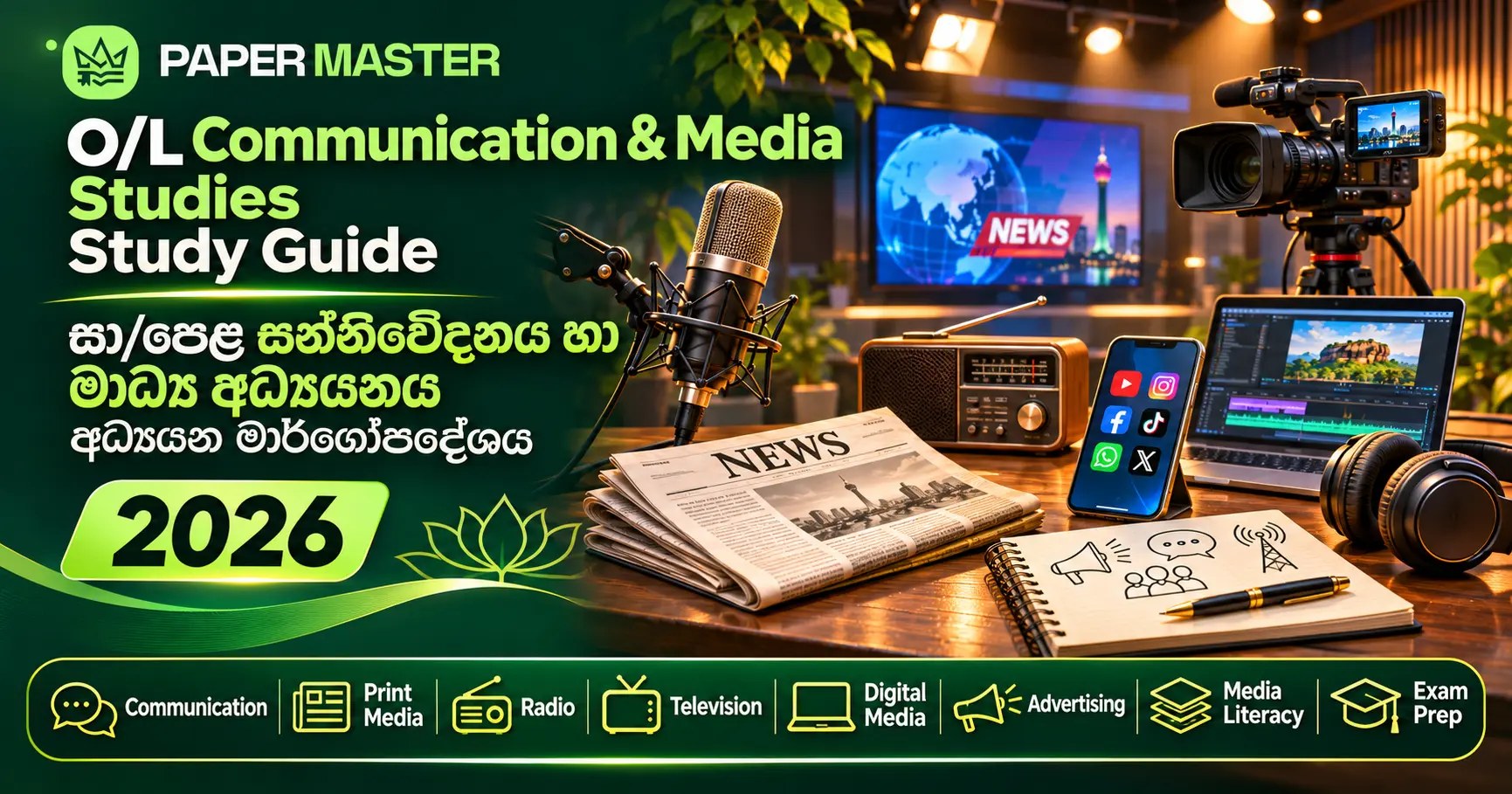
O/L Communication & Media Studies Study Guide 2026 – Complete Revision Guide
A complete O/L Communication & Media Studies Study Guide for Sri Lankan students covering communication processes, verbal and non-verbal communication, print and electronic media, news, advertising, social media, media literacy, ethics, past paper practice and exam preparation for the 2026 examination.
O/L Communication & Media Studies Study Guide 2026
This O/L Communication & Media Studies Study Guide is designed to help Sri Lankan students revise the important communication concepts, media knowledge, practical skills and critical thinking abilities required for the G.C.E. Ordinary Level examination.
Communication & Media Studies becomes easier when students connect theoretical concepts with real-life communication, newspapers, radio, television, advertising, websites and social media instead of simply memorizing definitions.
Communication is the process of sharing information, ideas, feelings and messages between people.
Communication is used in almost every area of daily life, including:
Education
Family life
Business
Government
Entertainment
Media
Social relationships
Important Tip
Do not memorize communication as a definition only.
Think about how communication takes place in real situations such as a conversation, telephone call, classroom lesson or television programme.
2. The Communication Process
A communication process usually involves several important elements.
These may include:
Sender
Message
Medium or channel
Receiver
Feedback
Context
Possible interference
Students should understand how a message moves from the sender to the receiver.
Revision Tip
Create simple examples of communication and identify each element separately.
3. Feedback
Feedback is the response given by the receiver after receiving a message.
Feedback helps the sender understand whether the message has been:
Received
Understood
Accepted
Misunderstood
Examples of feedback may include:
A spoken reply
A facial expression
A written response
A gesture
An online comment
Feedback is an important part of effective communication.
4. Types of Communication
Communication can take place in different ways.
Students should understand forms such as:
Intrapersonal communication
Interpersonal communication
Group communication
Public communication
Mass communication
Each form is suitable for different situations and audiences.
Important Tip
When studying communication types, learn one practical example for each type.
5. Verbal Communication
Verbal communication uses spoken or written language to communicate information.
Examples include:
Conversations
Speeches
Telephone calls
Letters
Messages
Reports
News articles
Effective verbal communication requires clear language and suitable word choice.
6. Non-Verbal Communication
Non-verbal communication communicates meaning without relying entirely on words.
Examples include:
Facial expressions
Hand gestures
Eye contact
Posture
Body movement
Images
Symbols
Signs
Important Tip
A person's body language may support, strengthen or sometimes contradict spoken words.
7. Communication Barriers
Communication may become ineffective when a message is interrupted or misunderstood.
Possible barriers include:
Noise
Language differences
Poor listening
Technical problems
Incorrect information
Cultural differences
Lack of attention
Unsuitable communication methods
Students should also understand how these barriers may be reduced.
8. Effective Communication
Effective communication should be:
Clear
Accurate
Relevant
Suitable for the audience
Easy to understand
Timely
Good communicators should also listen carefully and respond appropriately.
Communication Tip
Before communicating, think about who will receive the message and what they need to understand.
9. Understanding Media
Media refers to the channels and technologies used to communicate information to people.
Important media forms include:
Newspapers
Magazines
Radio
Television
Film
Websites
Social media
Digital platforms
Different media have different strengths, limitations and audiences.
10. Print Media
Print media communicates information through printed materials.
Examples include:
Newspapers
Magazines
Books
Leaflets
Posters
Brochures
Students should understand the role of print media in:
Information
Education
Advertising
Entertainment
Public awareness
11. Radio
Radio is an audio-based medium that communicates using sound.
Radio content may include:
News
Interviews
Music
Discussions
Educational programmes
Advertisements
Public announcements
Important Tip
Because radio does not depend on visual images, voice, sound effects and music are especially important.
12. Television
Television combines visual images and sound.
Television may be used for:
News
Education
Entertainment
Advertising
Sports
Documentaries
Public information
Students should understand how visual and audio elements work together to communicate a message.
13. Film and Visual Media
Film can communicate stories, ideas and emotions through:
Images
Dialogue
Acting
Music
Camera work
Editing
Lighting
Sound
Students should understand that visual choices can influence how audiences understand a message.
14. Internet and Digital Media
The Internet has changed the way people produce and receive information.
Digital media includes:
Websites
Social networks
Video platforms
Blogs
Podcasts
Messaging services
Online news
Important advantages include speed, accessibility and interactivity.
However, users should also consider accuracy, privacy and safety.
15. Social Media
Social media allows users to create, share and respond to content.
Students should understand both benefits and risks.
Benefits may include:
Fast communication
Sharing information
Education
Community building
Creative expression
Risks may include:
False information
Privacy problems
Cyberbullying
Harmful content
Online scams
Important Tip
Do not assume information is true simply because it has been shared many times.
16. News and Journalism
News provides information about events that are considered important to the public.
Students should understand basic ideas such as:
News gathering
News reporting
Accuracy
Sources
Headlines
Interviews
Facts and opinions
Good journalism should aim to communicate information accurately and responsibly.
17. Identifying Facts and Opinions
A fact can be checked using evidence.
An opinion expresses a person's belief, judgment or viewpoint.
Students should learn to distinguish between:
Verified information
Personal opinion
Advertising claims
Rumours
Misleading content
This is especially important when using online media.
18. Advertising
Advertising is used to communicate information about products, services, organisations or ideas.
Advertisements may use:
Images
Slogans
Music
Colour
Famous personalities
Emotional messages
Product information
Advertising Tip
When analysing an advertisement, ask who the target audience is and what action the advertiser wants the audience to take.
19. Target Audience
A target audience is the specific group of people for whom a media message is designed.
An audience may be identified by factors such as:
Age
Interests
Language
Location
Occupation
Lifestyle
Media producers often change language, images and style according to the target audience.
20. Media Messages
Media messages are constructed carefully.
When analysing a message, consider:
Who created it?
Why was it created?
Who is the target audience?
What techniques are used?
What information is included?
What information may be missing?
Thinking about these questions helps students become critical media users.
21. Media Literacy
Media literacy is the ability to access, understand, analyse and evaluate media content critically.
A media-literate person should:
Check sources
Compare information
Identify bias
Recognize advertising
Question suspicious claims
Protect personal information
Use media responsibly
Important Tip
Being able to use social media does not automatically mean a person is media literate.
Critical thinking is also necessary.
22. Misinformation and False Content
Incorrect information can spread quickly, especially through digital media.
Before sharing information:
Check the source
Check the date
Look for supporting evidence
Compare reliable sources
Be careful with sensational headlines
Avoid forwarding unverified information
Responsible media use helps reduce the spread of false information.
23. Media Ethics
Media professionals and users have ethical responsibilities.
Important principles include:
Accuracy
Fairness
Responsibility
Respect for privacy
Respect for others
Avoiding unnecessary harm
Correcting mistakes
Ethical media use helps build trust.
24. Privacy and Responsible Digital Communication
Personal information should be protected when using digital media.
Students should be careful about sharing:
Passwords
Personal photographs
Contact information
Private conversations
Location information
Sensitive personal details
Responsible communication also requires respectful behaviour toward other users.
25. Media and Society
Media can influence society in many ways.
It can:
Provide information
Educate people
Entertain audiences
Influence opinions
Promote products
Create awareness
Encourage social discussion
Students should understand that audiences can also respond to and influence media content.
26. Practical Communication Skills
Communication & Media Studies also requires practical thinking.
Students should practice:
Writing clear messages
Creating suitable headlines
Selecting suitable media
Identifying audiences
Organising information
Analysing advertisements
Evaluating media messages
Practical exercises make theoretical concepts easier to remember.
27. Answering Structured Questions
When answering structured questions:
Read the question carefully
Identify the communication or media concept
Give the correct definition or explanation
Use an example when helpful
Answer only what is required
Organise longer answers into clear points
Exam Tip
Pay attention to words such as define, identify, explain, compare and discuss.
They require different levels of detail.
28. Past Paper Practice
Past paper practice is one of the best ways to prepare for the O/L Communication & Media Studies examination.
Try to:
Complete past papers regularly
Practice MCQ questions
Practice structured questions
Review communication concepts
Analyse media examples
Practice news and advertising questions
Review digital media topics
Identify weak areas
Work within the examination time
Past papers help students understand how communication and media concepts are applied in examination questions.
Common Mistakes to Avoid
Memorizing definitions without understanding them
Confusing communication types
Forgetting the role of feedback
Giving examples without explanations
Confusing facts and opinions
Accepting online information without checking it
Writing unrelated information
Ignoring the exact requirement of the question
Spending too much time on one question
Exam Preparation Tips
Create short notes for communication concepts
Learn practical examples
Review communication types
Study print and electronic media
Revise digital and social media
Practice media analysis
Review news and advertising concepts
Study media ethics
Complete past papers
Review your mistakes carefully
Final Advice
Communication & Media Studies becomes easier when you connect classroom concepts with the media and communication you experience every day.
Understand how messages are created, transmitted and interpreted, and learn to evaluate media content critically instead of accepting every message immediately.
Regular revision, practical examples, media observation and past paper practice will help improve both your knowledge and confidence before the examination.
Use PaperMaster.lk to access past papers, model papers, study guides and educational resources for your O/L examination preparation.
Good luck with your studies and your 2026 O/L examination!