Skip to main content
O/L Business & Accounting Studies Guide 2026 | PaperMaster.lk | PaperMaster LK
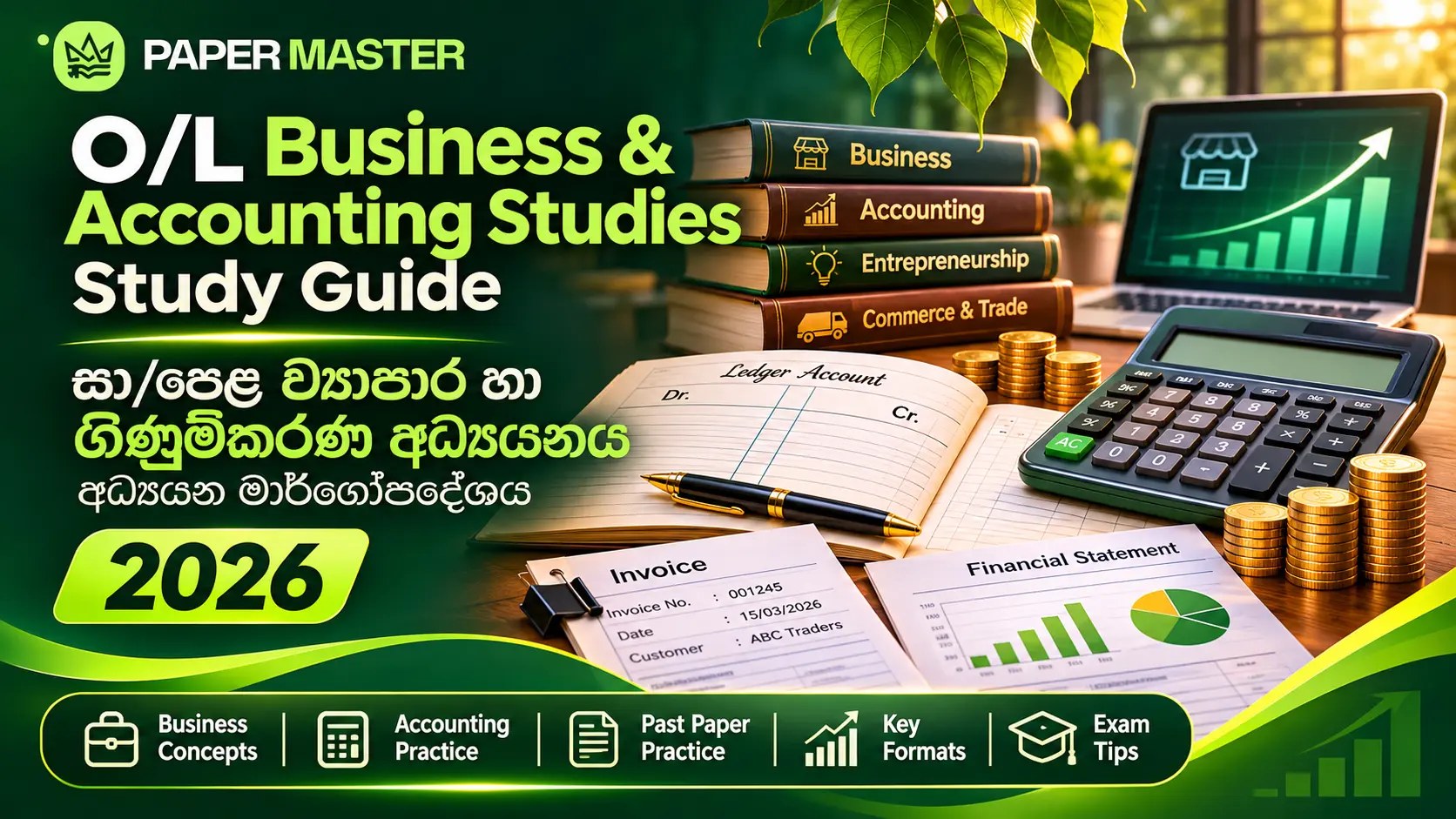
Home Study Guides O/L Business & Accounting Studies Study Guide 2026 – Complete Revision Guide A complete O/L Business & Accounting Studies guide for Sri Lankan students covering business concepts, entrepreneurship, accounting principles, transactions, financial statements, banking, trade, past paper practice and exam preparation for the 2026 examination.
O/L Business & Accounting Studies Study Guide 2026 This O/L Business & Accounting Studies Study Guide is designed to help Sri Lankan students revise the important business and accounting concepts required for the G.C.E. Ordinary Level examination.
The subject becomes much easier when students understand how businesses operate and how financial transactions are recorded instead of simply memorizing definitions and formats.
What You Will Learn 1. Understanding Business A business is an organization or activity that provides goods or services to satisfy human needs and wants.
Students should understand:
Ready to practise?
Browse past papers More study guides O/L Buddhism Study Guide 2026 – Complete Revision Guide
A complete O/L Buddhism Study Guide for Sri Lankan students covering the life of the Buddha, Buddhist teachings, the Noble Eightfold Path, moral values, Buddhist culture, important events, past paper practice and exam preparation for the 2026 examination.
O/L Geography Study Guide 2026 – Complete Revision Guide
A complete O/L Geography Study Guide for Sri Lankan students covering physical geography, maps, climate, population, natural resources, agriculture, industries, environmental issues, past paper practice and exam preparation for the 2026 examination.
O/L Sinhala Language & Literature Study Guide 2026 – Complete Revision Guide
A complete O/L Sinhala Language and Literature study guide for Sri Lankan students covering grammar, comprehension, essay writing, literature, poetry, prose, language skills, past paper practice and exam preparation for the 2026 examination.
Important Tip Try to connect business concepts with real businesses you see in everyday life.
This makes definitions easier to understand and remember.
2. Entrepreneurship An entrepreneur identifies opportunities and organizes resources to create and operate a business.
Important qualities of an entrepreneur may include:
Revision Tip When studying entrepreneurship, think about how each quality can help a person successfully operate a business.
3. Business Organizations Businesses can operate under different forms of ownership.
Students should understand the basic characteristics of:
Important areas to compare include:
Creating a comparison table can make this section easier to revise.
4. Business Resources Businesses require different resources to carry out their activities.
Students should understand why each resource is important to a business.
5. Trade and Commerce Trade involves buying and selling goods and services.
Students should understand:
Important Tip Learn the difference between wholesale and retail trade using real-world examples.
6. Banking and Financial Services Banks play an important role in business and everyday financial activities.
Students should understand services such as:
Students should also understand the importance of using financial services responsibly.
7. Introduction to Accounting Accounting is the process of recording, classifying, summarizing and interpreting financial transactions.
Accounting helps a business understand its financial position and performance.
Important concepts include:
Important Tip Understand what each accounting term means before trying to solve accounting questions.
8. The Accounting Equation The basic accounting equation is:
Assets = Capital + Liabilities
Students should understand how business transactions affect this equation.
Practice several transactions until you can identify which elements increase or decrease.
9. Business Transactions A business transaction is an event that has a financial effect on a business.
Students should carefully identify the accounts affected by each transaction.
10. Source Documents Business transactions are supported by documents.
Students should be familiar with documents such as:
Revision Tip Understand the purpose of each document and when it is used.
11. Books of Original Entry Transactions are first recorded in appropriate books before being transferred to ledger accounts.
Students should revise the purpose and use of relevant books of original entry.
When practicing, pay attention to:
Accuracy is very important in accounting questions.
12. Ledger Accounts Ledger accounts are used to classify transactions under separate accounts.
Students should understand:
Accounting Tip Always determine which account is being debited and which account is being credited before recording the transaction.
13. Income and Expenses A business earns income and incurs expenses during its operations.
Examples of income may include:
Examples of expenses may include:
Students should be able to distinguish between income and expenses correctly.
14. Financial Statements Financial statements help determine the performance and financial position of a business.
Students should understand the basic purpose of statements used to identify:
Important Tip Learn the correct structure of each statement and practice preparing them using different questions.
15. Profit and Loss Profit occurs when income is greater than expenses.
A loss occurs when expenses are greater than income.
Students should understand how business decisions can affect profit.
Understanding these relationships is useful for both theory and calculation questions.
16. Business Communication Effective communication is important for every organization.
Students should understand different communication methods, including:
A suitable communication method depends on the purpose, urgency and audience.
17. Consumers and Business Responsibility Businesses have responsibilities toward customers, employees and society.
Students should understand topics such as:
Responsible business practices can help create long-term trust.
18. Past Paper Practice Past paper practice is one of the best ways to prepare for the O/L Business & Accounting Studies examination.
Past papers help students become familiar with examination question patterns.
Common Mistakes to Avoid
Exam Preparation Tips
Final Advice Business & Accounting Studies becomes easier when theory is combined with regular accounting practice.
Do not only read accounting examples. Write out the entries and calculations yourself.
Understand how real businesses operate and connect those examples with the concepts you learn in the syllabus.
Regular revision, calculation practice and past paper preparation will help improve both your accuracy and confidence.
Use PaperMaster.lk to access past papers, model papers, study guides and educational resources for your O/L examination preparation.
Good luck with your studies and your 2026 O/L examination!